


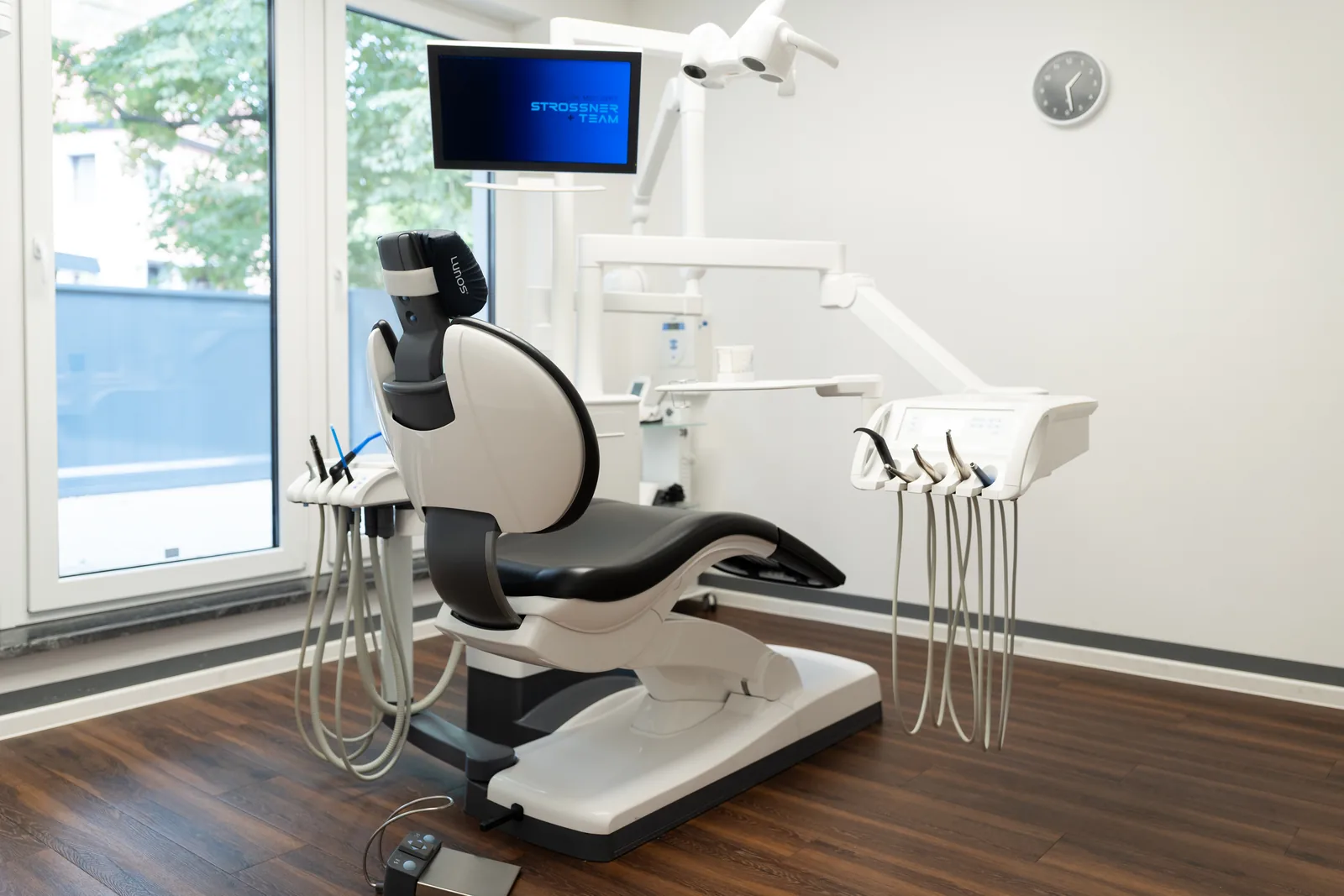
Our Medical Technology
From X-ray to finished tooth, with no detours
For us, digital does not mean “modern for technology's sake” – it means fewer impressions, fewer appointments and fewer surprises.
Who treats you
Dr. med. dent. M.Sc. Sandro Strößner – working in implantology since 2013 · M.Sc. in Oral Implantology and Periodontology – together with the team at Zahnkompetenzzentrum Weißenfels.
First Appointment
Consultation, medical history and examination (3D X-ray if needed) – we plan first and treat later. A pure information meeting without examination is non-binding; the examination and the cost plan are charged according to the GOZ fee schedule.
Costs
A written treatment and cost plan before treatment begins; an initial, non-binding price range is provided by the cost calculator further down.
First Step
Appointments online around the clock (“Appointment” button) or by phone during opening hours on 03443 339 65 54.
“For patients from Leipzig, the practice is about 40 minutes by car (A9) south-west of the city. At our Zahnkompetenzzentrum, they receive All-on-4, ceramic implants and complex bone augmentation.”
The Principle
Cone-beam CT scan, intraoral scans, structured assessment. The first appointment isn't treatment — it's a conversation backed by data.
From the final dental prosthesis back to the surgery. What should exist at the end determines the first step — not the other way round.
One team under one roof: surgery, prosthetics, laboratory.
Our Medical Technology
For us, digital does not mean “modern for technology's sake” – it means fewer impressions, fewer appointments and fewer surprises.
01
03
05
Transparency regarding costs and procedures is important to us: you receive a detailed treatment and cost plan and discuss alternatives. We also provide second opinions without any subsequent treatment.
Short videos in which our team answers the questions we're asked most often. No jargon, no sales pressure.
The videos provide general information and do not replace individual advice or examination. The course and outcome of treatment depend on personal circumstances; medicine offers no guarantee of success. All videos have subtitles.
SPECIALISATION
Anyone looking for an implant specialist in Leipzig faces a large market – and, at the same time, the question of how to recognise treatment that is genuinely focused on implantology. A dental implant is an artificial tooth root that is anchored in the jawbone and replaces a lost tooth in its original position. Unlike bridges or removable dentures, which rely on neighbouring teeth or the mucosa for support, the implant takes on the load-bearing function of the natural root directly in the bone. The visible restoration – a crown, a bridge, or a permanently screwed-in denture – is attached to this foundation.
The Zahnkompetenzzentrum Dr. med. dent. M.Sc. Sandro Strößner is located in Weißenfels, about 40 minutes by car (A9) south-west of Leipzig.
In dental law, the term “specialist” is not protected in the same way as, for example, the specialist title in human medicine. That makes it all the more important to look behind the word: what does a practice actually focus on? How many implant treatments does it carry out? What further training, what diagnostics and what procedures does it offer? On this page, we explain what implantological specialisation involves, how it differs from the range of services of a general dentist, what the journey from Leipzig to Weißenfels looks like and which treatments we offer. This allows you to judge for yourself whether the journey to Weißenfels makes sense for you.
Implant treatment requires forward-looking planning of the bone and soft tissue, a safe surgical approach, an understanding of the later prosthetic loading and consistent aftercare. The more frequently a practice carries out such treatments and the more systematically it has aligned its processes to them, the better diagnostics, planning and the procedure are generally coordinated with one another. Specialisation never replaces the individual assessment of suitability in each case – but it creates an environment in which complex starting situations can be assessed with the necessary experience.
QUALIFICATION
Anyone planning implant treatment understandably wants to know whose hands they are placing themselves in. Since the term “implant specialist” is not a uniformly defined title, it is worth taking a closer look at the verifiable features behind a practice's focus on implantology. The following points help you assess a practice objectively – regardless of whether it is located in Leipzig itself or in the surrounding area.
Implantology is a field that continues to evolve – in diagnostics, in materials and in surgical procedures. Specialisation is reflected in a practice pursuing structured further training and naming its area of focus transparently. Curricular training programmes run by scientific professional societies, more in-depth structures such as the “special focus in implantology” (Tätigkeitsschwerpunkt Implantologie) or a further degree with a Master of Science qualification are ways in which dentists gain qualifications beyond their basic training. Dr. Strößner holds the academic degree Master of Science, which stands for an in-depth, part-time postgraduate course of study.
Honesty matters here too: further training is evidence of commitment and professional engagement, but it is not a promise of a particular treatment outcome. In a personal conversation, we are happy to explain which methods we use and how we plan your treatment.
A practice focused on implantology can also be recognised by its equipment and its processes. These include modern imaging for a three-dimensional assessment of the jaw, digital planning methods, a consistent hygiene concept and structured patient information with a written treatment and cost plan. Just as telling is how a practice deals with borderline cases: is it openly discussed when an implant is not the best solution? Are alternatives mentioned? Are risks explained in concrete terms?
At the Zahnkompetenzzentrum Dr. med. dent. M.Sc. Sandro Strößner, diagnostics, planning, the surgical procedure, prosthetic treatment and aftercare all come together at a single location. For patients from Leipzig, this means that their treatment is not spread across several practices, but is coordinated in one place.
A general dentist covers the full breadth of dentistry: preventive care, fillings, root canal treatment, dental prosthetics, and often simple surgical procedures too. This broad range of care is valuable for everyday needs and is exactly the right point of contact for many types of treatment. For a plannable, demanding procedure such as implant placement, however, it can make sense to specifically seek out a practice with an implantology focus – much as one would choose a practice with the right specialism for a particular question in medicine generally. This is not about “better” or “worse”, but about finding the right point of contact for the task at hand.
The difference shows itself less in any single hand movement than in the overall concept. A specialised practice has aligned its workflows, diagnostics, and training with this particular focus. It also regularly encounters more unusual starting situations and, on this basis, can assess which approach suits which situation. This concentration of focus matters particularly when bone is limited, several teeth are missing, or an edentulous jaw needs to be restored. No general statement about outcome can be drawn from this – but there is a reasonable expectation that complex cases will be planned with the necessary routine experience.
On request, we coordinate with your regular dentist so that preventive care in Leipzig and implant treatment with us work hand in hand. This way, you do not have to give up your usual dental care.
DIRECTIONS FROM LEIPZIG
Weißenfels is located in southern Saxony-Anhalt, in the Burgenlandkreis, and is easy to reach from Leipzig. By car, the route usually runs via the A9 motorway and the B91 main road; depending on your starting point within the city and traffic conditions, the journey generally takes around 40 minutes. Those starting from the south or south-west of Leipzig are often there a little faster still.
Weißenfels is also connected by rail. There are services from Leipzig main station towards Weißenfels, so travelling without your own car is possible too. It is best to check the current, up-to-date timetable directly with the rail operator, as connections and journey times can change. After sedation or general anaesthesia you may not drive for 24 hours; a companion takes you home.
In Weißenfels, you can usually find parking without a long search, distances are short, and the surroundings are calmer than in a big-city centre. Instead of searching for a parking space in city traffic and arriving flustered, you can approach your appointment calmly – which particularly suits people who already feel a little uneasy before dental treatment.
We know that a longer journey calls for forward-looking appointment scheduling. That is why we try to arrange appointments for patients from further afield so that travel and treatment fit together well, and, where medically appropriate, to combine several steps sensibly to keep the number of journeys manageable. Many phases of consultation, planning, and treatment can be arranged so that the effort involved stays as low as possible for those travelling in. Talk to us about your journey from Leipzig, and together we will find a workable solution.
RANGE OF TREATMENTS
Implants are not a procedure for a single type of case, but a treatment basis for very different starting situations. Which option is suitable depends on the number of missing teeth, the condition of the remaining teeth and the available bone. The following overview gives a summary of the restorations possible with implants – we determine the specific choice together after a thorough examination.
Forward-looking planning is the foundation of good implant treatment. Three-dimensional X-ray diagnostics allow the jaw to be assessed spatially, not just as a flat image. This reveals bone height, bone width and the position of anatomical structures such as nerve canals or the maxillary sinus, which are only partially visible on a classic two-dimensional X-ray. On this basis, we plan the position, size and axis of the implant and realistically assess whether bone augmentation is needed.
From the three-dimensional data, the planned implant position can be transferred into an individually made surgical guide, which directs the procedure along the previously determined axis and depth. This guide-led approach connects planning on screen with execution in the mouth, and takes into account, right from the start, how the eventual dental prosthetics should look and be loaded. This means the implant is positioned not only favourably from a surgical point of view, but also sensibly from a prosthetic one.
Two materials are mainly available for the implant itself. Titanium implants have been in use for decades and are known for their good compatibility and mechanical strength; they are used in most situations. Ceramic implants – usually based on zirconium oxide – are metal-free and naturally tooth-coloured, which can offer aesthetic advantages, particularly in the visible front-tooth area or where the gum tissue is very thin. Which material is right for you depends on the location of the gap, the aesthetics you want, the available bone volume, and your personal preferences. There is no single best solution overall, only one that suits you individually, which we will discuss together.
Many people feel tense, particularly before a surgical procedure. On request, implant placement at our practice can be accompanied by sedation to reduce this tension. Which form of support is suitable for you depends on the treatment, your state of health, and your preferences, and is discussed calmly in advance. After sedation or general anaesthesia you may not drive for 24 hours; a companion takes you home.
PROCESS FOR THOSE TRAVELLING IN
Implant treatment is a planned process that extends over several appointments and weeks. Between individual phases, deliberately chosen healing periods allow the tissue to settle. For patients from Leipzig, who have a journey of about 40 minutes by car (A9), it is worth looking at the typical course of treatment, so that journeys and appointments can be well planned. The specific order and duration always depend on your personal situation and may vary in individual cases.
Where medically justifiable, we try to combine treatment steps sensibly for patients travelling from further afield, to keep the number of journeys manageable. Whether a shortened approach – for example, when the implant and the temporary restoration follow each other closely in time – is suitable for you depends on bone quality, the stability achieved by the implant, and its position in the jaw, and is carefully assessed in each individual case.
You remain closely involved throughout the entire treatment. Before every major step, we explain what happens next, what to look out for at home, and when the next appointment makes sense. This way, you keep an overview of how your treatment is progressing, even across a distance.
ADVANTAGES & BONE AUGMENTATION
A practice with a focus on implantology brings several advantages that come into play particularly for a planned, demanding procedure. The following points summarise why the journey can be worthwhile – always provided the individual circumstances are suitable, and suitability is assessed on a case-by-case basis.
An implant needs sufficient load-bearing bone in order to be anchored securely. However, after a tooth has been missing for a longer period, the jawbone often recedes, because it no longer receives natural stimulation from the tooth root. Inflammatory processes or anatomical factors can also mean that there is not enough bone at the desired site. In such cases, bone augmentation can restore the missing volume, thereby first creating the conditions needed for an implant.
Depending on its extent, bone augmentation can be carried out at the same time as implant placement, or as a separate, preliminary procedure. If it is carried out separately, the augmented area first needs its own healing period before the implant is placed. Whether bone augmentation is needed at all can only be assessed after a precise examination – in many cases, the available bone is sufficient. Where it is not, the procedures described often still open the way to an implant. We discuss transparently what additional effort this involves and how it affects treatment duration, the number of journeys, and cost.
COSTS & INSURANCE
The cost of implant treatment depends on many factors: the number of implants, the material used, the type of dental prosthesis, and whether bone augmentation or other preliminary treatment is needed. For this reason, no flat-rate price can be given. Before treatment begins, we provide you with a written, comprehensible treatment and cost plan listing every item, so that you have a clear basis for your decision.
We understand that the financial side of implant treatment plays an important role. That is why we discuss together which restoration makes medical sense while also fitting your circumstances, and explain the treatment and cost plan item by item. On request, we can also discuss possible payment arrangements, so that treatment remains manageable to plan – travelling from Leipzig does not add any extra treatment costs.
Statutory health insurers pay a fixed subsidy for dental prosthetics based on the diagnosis, calculated against standard care. As the implant itself usually goes beyond standard care, an out-of-pocket share generally remains. Keeping a bonus booklet regularly and without gaps can increase the subsidy. The fixed subsidy is regulated uniformly across Germany – so as a patient insured in Leipzig, you have the same entitlement as you would for treatment in Saxony. Privately insured patients and those with supplementary insurance should clarify reimbursement with their insurer in advance, as conditions vary by tariff. We are happy to prepare a treatment and cost plan for you that you can submit to your health insurer before treatment begins – simply get in touch with us on 03443 / 339 65 54.
The Zahnkompetenzzentrum Dr. med. dent. M.Sc. Sandro Strößner in Weißenfels is an easily accessible point of contact for implants and high-quality dental prosthetics. Diagnostics, planning, the surgical procedure, prosthetic treatment and aftercare all take place at a single location, so that your treatment is coordinated in one place and you do not have to switch between several practices. On request, we coordinate with your regular dentist in Leipzig so that preventive care and implant treatment dovetail.
If you are considering an implant, or are unsure which restoration is right for you, a personal consultation is the best first step. During this, we look at your situation, answer your questions and show you the possible options – objectively, clearly and without time pressure. Feel free to book an appointment by telephone on 03443 339 65 54. We take time for your concerns and support you on the way to your dental prosthetics.

For patients from Leipzig, the practice is about 40 minutes by car (A9) south-west of the city. At our Zahnkompetenzzentrum, they can have All-on-4, ceramic implants and complex bone augmentation.
The journey from Leipzig via the A9 takes about 40 minutes. We have plenty of free parking spaces directly at the practice and, if you are travelling a longer distance, we arrange treatments so that you need as few appointments as possible.
What convinced me was the absence of marketing. No promises. Just planning, explanation, execution. I had eight implants placed and didn't even feel like I'd made a difficult decision.
At the Zahnkompetenzzentrum
Fixed Dental Restoration on Your Own Root
Working in implantology since 2013
Immediate Treatment of the Jaw
All Services at a Glance
No-Obligation Cost Calculator
Process, Technique, Immediate Treatment
Upload your cost plan, call-back within two working days
Computer-navigated implant placement in real time. See how an implant procedure takes place at our Zahnkompetenzzentrum.
This video contains no spoken content. The audio track consists solely of subtle background music — no spoken or meaning-bearing audio information is lost.
Answer a few short questions and you’ll immediately receive a transparent price range for your situation — complete with a clear breakdown and possible monthly instalment.
As a rule X-Guide 3D-navigated & minimally invasive. We plan your implant on the computer and, as a rule, place it with navigation to within a millimetre — through a particularly small, tissue-sparing access point. This extra effort is already built into every price.
You now know your approximate investment. In the information consultation we clarify which restoration makes sense for your case – and whether there might be a simpler way.
A no-obligation information meeting, without treatment. Examination, any necessary X-ray diagnostics and the written treatment and cost plan are carried out according to medical indication and charged under the GOZ; we tell you the costs in advance. You decide at your leisure.
A non-binding estimate for initial guidance only — not a treatment and cost plan, and no substitute for a personal consultation. The actual cost depends on your individual findings and is set out in a written treatment and cost plan showing the expected costs.
Get practical dental health tips and news from our practice — free, and you can unsubscribe at any time.
